Every January, the American Medical Association (AMA) refreshes the CPT code set. Most years it's a quiet job. A few codes in, a few out, billing teams adjust, everyone moves on.
2026 was different, and not because of the volume. Last year's update actually had slightly more changes. What made this one matter is that whole sections of the code book were torn up and rebuilt from scratch, and artificial intelligence stopped being a placeholder and started showing up in real code descriptors.
If you sell into health systems, this is one of the better market signals you'll get all year.
The numbers
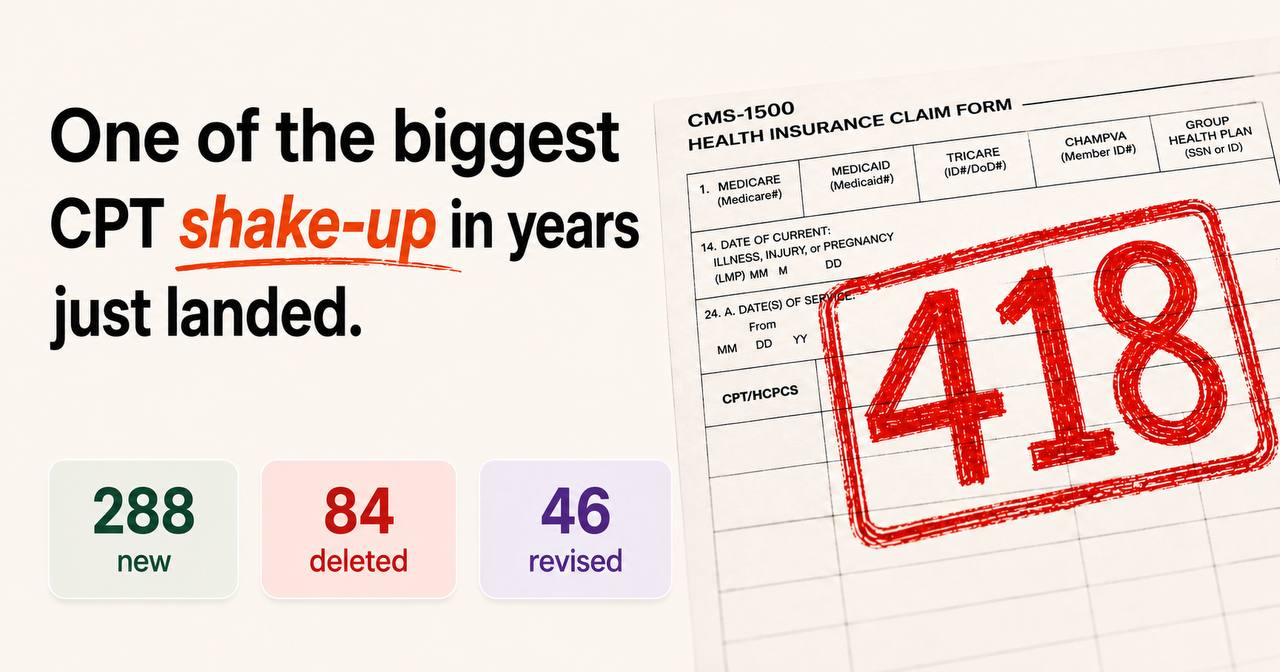
The AMA approved 418 total changes: 288 new codes, 84 deletions, and 46 revisions, all effective January 1, 2026.
Two buckets dominated the additions. PLA codes (branded lab tests) made up about 27%. Category III codes made up another 27%.
Category III is worth understanding, because it explains how to read the rest of this. It's the waiting room: temporary codes for new technology, sitting there while payers watch how often something actually gets used. Moving out of Category III into Category I means a procedure is now considered established. That's a real milestone, and it happened to several technologies this year.
Leg revascularization: rebuilt around anatomy
The biggest single change. The old family of lower-extremity revascularization codes (37220 through 37235) was deleted and replaced with 46 new codes in the 37254–37299 range.
The logic flipped. Instead of coding mainly by device or technique, the new structure organises work by vascular territory: iliac, femoral/popliteal, tibial/peroneal, and inframalleolar (below the ankle). Within each one, codes separate straightforward cases (a narrowing) from complex ones (a full blockage).
It's a better match for how vascular work is actually done. It was also a brutal retraining job, and January was messy for a lot of coding teams.
Coronary work changed too, but differently
This gets conflated with the above, and it shouldn't be. Coronary intervention did not move to a territory model. Coronary codes are still organised by vessel.
What changed is that separate add-on codes for treating additional branches were folded into the main codes. 92921, 92925, 92929, 92934, 92938 and 92944 were deleted, with parent codes reworded to cover branches. Two new codes arrived: 92930 for multi-lesion and bifurcation stenting, and 92945 for chronic total occlusion using combined antegrade and retrograde approaches.
If you sell into cath labs, that distinction matters. Getting it wrong in a customer conversation is the kind of thing that ends your credibility in one sentence.
Hearing devices: a 1993 code set finally retired
The old hearing aid service codes (92590 through 92595) were written in 1993, when hearing aids were analog.
They were deleted and replaced with 12 new codes (92628–92642) that follow the real arc of care: candidacy, device selection, fitting, verification, follow-up. Several are time-based, acknowledging that a simple fitting and a complex one aren't the same job.
One catch worth knowing: these cover the audiologist's professional services only. The HCPCS "V" codes for the devices themselves are unaffected.
Talk to Intent.Health →A technology graduated, and it's filed in the wrong place
Baroreflex activation therapy (BAT) moved out of the waiting room. Category III codes 0266T–0273T were deleted and replaced with permanent codes 64654–64659, plus interrogation codes 93145 and 93146.
Here's the trap. These codes live in the nervous system section of the code book, so they get filed under "neuro." Clinically, BAT is a heart failure therapy. The lead goes onto the carotid sinus, and the American College of Cardiology, not a neurosurgery body, published the coding guidance. Build a target list off the code section alone and you'll aim at entirely the wrong service line.
AI stopped being theoretical
The AMA has had an AI framework since 2022, in Appendix S. It sorts tools by how much work the machine does:
- Assistive: the software flags something but doesn't analyse it. A clinician interprets and reports.
- Augmentative: the software analyses or measures data and produces a result. A clinician still signs off.
- Autonomous: the software reaches a conclusion on its own, with little or no clinician involvement.
In 2026 that framework got teeth. Real services got real codes: AI-supported coronary CT analysis, perivascular fat analysis for cardiac risk, algorithmic ECG analysis, multispectral burn wound imaging.
The one to know by name is 75577, a Category I code for coronary plaque measurement from CT angiography using augmentative software. It replaced Category III codes 0623T–0626T. AI-supported analysis is now an established service, not an experiment.
The catch: billing these requires documentation naming the software, explaining what it contributed, and recording the clinician's own reading. "We used AI" doesn't cut it.
And it's still moving. In May 2026 the CPT Editorial Panel approved further Appendix S revisions, sharpening the line between assistive and augmentative. Those take effect January 1, 2027.
The change most write-ups skipped: remote monitoring
Remote patient monitoring had two hard cliffs. To bill for the device, a patient needed to transmit data on at least 16 days in 30. To bill for clinical time, staff needed at least 20 minutes in a month. Fifteen days or nineteen minutes got you nothing.
That never matched real care. Plenty of patients only need a short burst of monitoring during a medication change or after a hospital stay.
Two new codes fixed it:
- 99445: device supply and data transmission for 2 to 15 days in a 30-day period.
- 99470: the first 10 minutes of management time in a calendar month, with at least one live patient conversation.
You can't bill 99445 alongside 99454, or 99470 alongside 99457. Pick the one that matches. And the setup code 99453 now needs at least two days of monitoring to qualify.
Small on paper. Big for anyone running an RPM programme, because a lot of previously unbillable patient-months just became billable.
Talk to Intent.Health →The part everyone forgets: a code is not payment
A new CPT code means a service can be described. It does not mean an insurer agreed to pay for it. Separate decisions, separate people, separate timelines.
Category III coverage is patchy by design. PLA coverage varies by payer. The new hearing device codes launched with no assigned relative value units and are carrier-priced, and Medicare has never covered hearing aids anyway. Some payers were still accepting deleted codes months into 2026.
The honest sequence: code exists → payer decides → contract reflects it → money moves. Skip to the last step and you'll be disappointed.
What this means if you sell into health systems
A graduation is a green light. When something moves to Category I, hospitals plan capacity differently and physician champions can make the internal case more easily. If you sell one of those technologies, your pitch improved on January 1.
A deleted code is a disruption window. Every vascular programme and audiology practice in the country rebuilt templates and retrained staff in January. Disruption is when organisations reassess vendors. Those windows close fast.
Bundling changes the economics. When branch codes fold into a parent code, revenue per case shifts, and any ROI model built on the old structure is describing a world that no longer exists.
Category III is your early-warning list. It shows what's moving from pilot toward standard practice, usually a year or three before anyone calls it a trend.
And knowing where to aim beats knowing the codes. A coding change ripples through revenue cycle, the service line, IT, and contracting. At an IDN or corporate owner, some of those calls sit at the parent level, not the hospital. Working out which entity decides, and who inside it feels the pain, is usually the difference between a meeting and a deal. That's what we work on at Intent.Health, but the principle holds whatever tools you use.
Talk to Intent.Health →CPT® is a registered trademark of the American Medical Association. This post is a general overview and isn't coding, billing, or legal advice. Always check the official CPT 2026 Professional Edition and your specific payer policies.
Sources
- AMA, "AMA releases CPT 2026 code set"
- AMA, "288 new CPT codes cover digital health, AI and more"
- AMA, "CPT Appendix S: AI taxonomy for medical services and procedures"
- AMA, "How CPT codes pave the path for AI in clinical practice"
- AMA, "CPT® PLA Codes"
- AMA, "CPT code set keeps pace with health care technology, innovation" (2025 figures, for the volume comparison)
- American College of Cardiology, "Coding Corner: Overview of New CPT Codes for 2026"
- ASHA, "New hearing device services codes"
- Nixon Law Group, "CMS finalizes 2026 remote monitoring reimbursement updates"
- Noridian Medicare, "Remote Physiologic Monitoring (RPM): 2026 Evaluation and Management Updates"
- Wolters Kluwer, "CPT 2026 code set updates"